Palpitations, skipped heartbeats, dizziness, or feeling faint could be warning signs from the body indicating a cardiac arrhythmia. Often, these symptoms occur only briefly and then disappear, meaning a standard electrocardiogram (EKG/ECG), which takes only a few minutes at the hospital, might not detect any abnormalities.
This is why cardiologists recommend using a Holter Monitor to assist in the diagnosis.
What is a Holter Monitor?
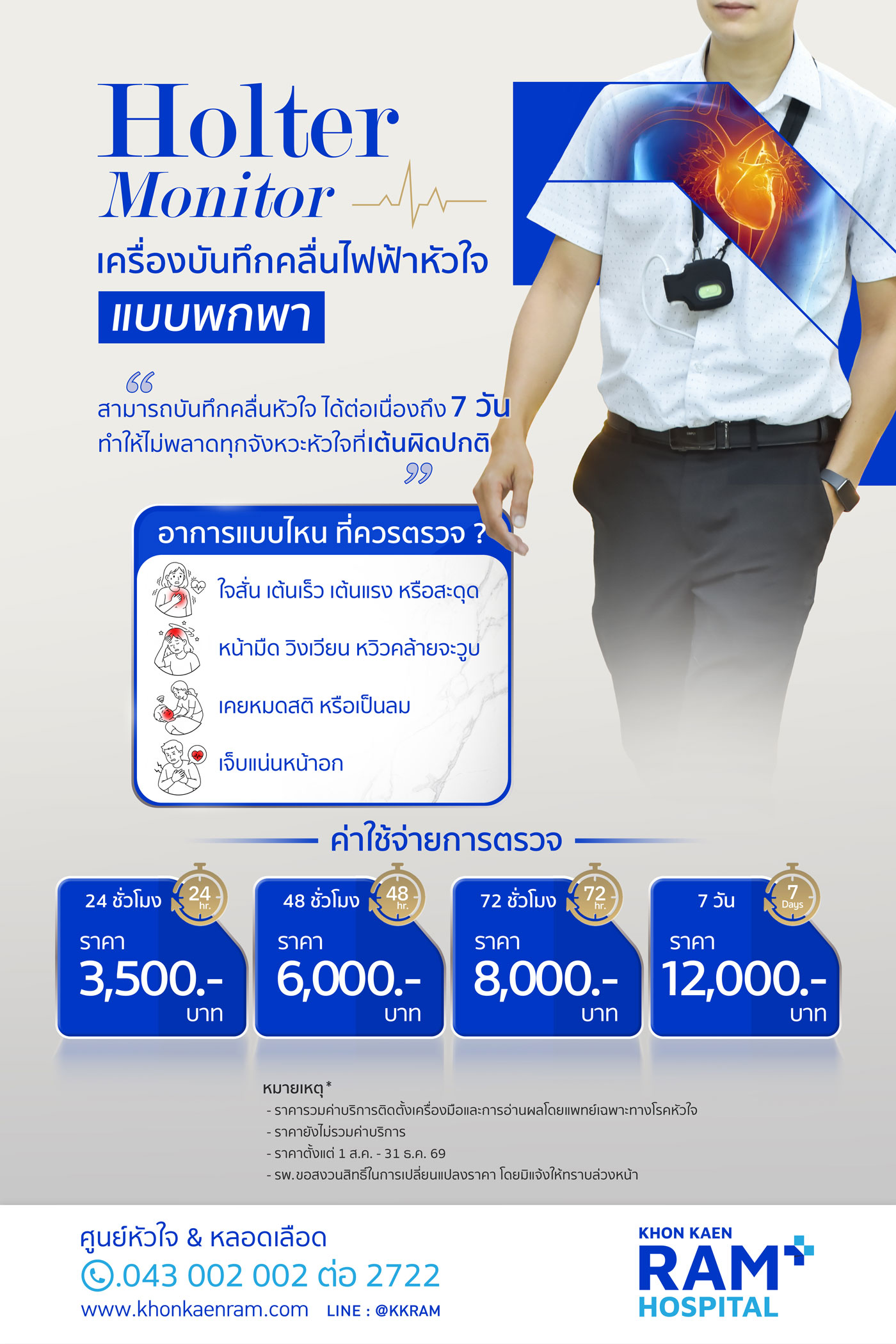
It is a small, portable electrocardiogram recording device used to continuously record the heart's electrical activity (heart function) for 24, 48, 72 hours, or up to 7 days (at the doctor's discretion). It records while the patient goes about their normal daily life—whether working, eating, or sleeping—in order to catch any hidden abnormal heart rhythms.
What symptoms warrant a Holter Monitor test?
- Palpitations, feeling a fast, pounding, or skipped heartbeat that does not occur all the time
- Dizziness, lightheadedness, or feeling faint
- A history of fainting or passing out (syncope)
- Unexplained chest pain, tightness, easy fatigue, or weakness
- For heart disease patients, to monitor treatment outcomes or check the efficiency of a pacemaker
Preparation before attaching the device
Shower and clean your body before coming to the hospital, as once the device is attached, it cannot be removed until the recording period is complete.
Holter monitor testing procedures
- Medical staff will clean or shave chest hair to attach electrodes, which are connected by wires to the Holter monitor device (measuring approximately 3.5 x 2.5 inches).
- Once the Holter monitor is attached, the doctor will provide instructions on how to behave while wearing the device.
- After the designated 24, 48, 72 hours, or 7 days, the patient must return the device to the hospital at the scheduled appointment time. The staff will remove the device. A cardiologist will then process the recorded data using a computer and analyze it to detect any abnormalities and plan appropriate, targeted treatment.
Comparison Table between Standard Electrocardiogram (EKG/ECG) vs. Continuous Electrocardiogram (Holter Monitor)
| Comparison Topic | EKG | Holter Monitor |
|---|---|---|
| Test Duration | Takes only 5 - 10 minutes | Continuously records heart's electrical activity for 24, 48, 72 hours, or 7 days (at the doctor's discretion) |
| Location & Lifestyle |
Tested at the hospital | Small portable device; allows you to go about your normal daily life, such as working, eating, or sleeping |
| Accuracy in Detecting Hidden Symptoms |
May not detect abnormalities if the arrhythmia occurs only briefly and then disappears | Can effectively catch hidden abnormal heart rhythms |
| Limitations | Short testing time, no lifestyle restrictions | Cannot be removed once attached (no showering) until recording is complete |
Holter Monitor Testing Prices
- 24-hour recording: 3,500 THB *
- 48-hour recording: 6,000 THB *
- 72-hour recording: 8,000 THB *
- 7-day recording: 12,000 THB *
Remarks *
- The price includes device installation and result reading by a cardiologist.
- The price does not include hospital service fees.
- Prices are valid from Aug 1 - Dec 31, 2026.
- The hospital reserves the right to change prices without prior notice.
For More Information
- Cardiovascular Center, 2nd Floor, Building 2, Tel. 043 002 002 ext. 2722
- Health Information Service Center, ext. 1905