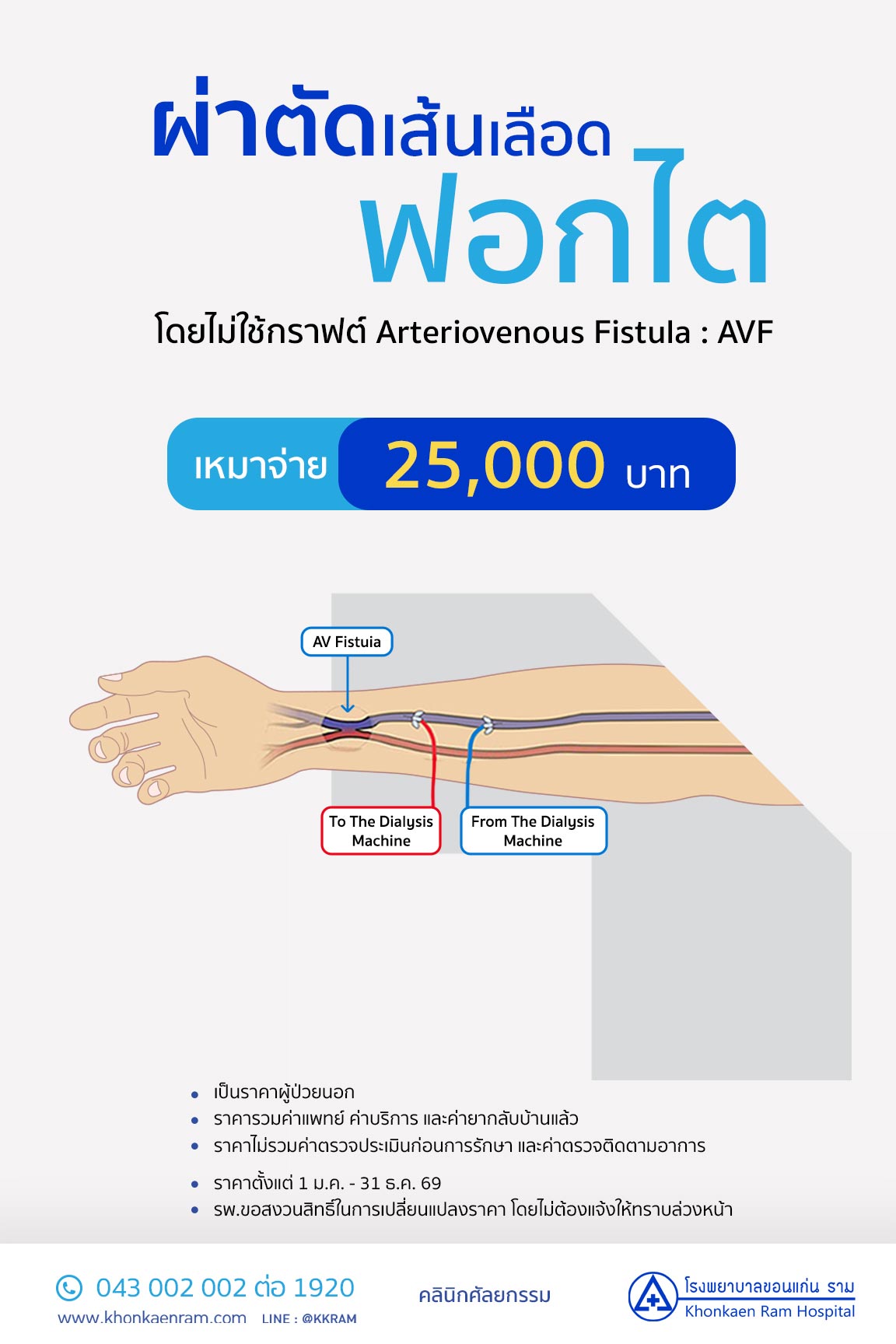
Arteriovenous Fistula (AVF) Surgery for Dialysis
Chronic kidney failure patients who choose hemodialysis as their treatment method will receive guidance on preparation and must understand the treatment process.
One of the most crucial aspects is that the patient must have a good vascular access for dialysis, as treatment is required at least 2-3 times per week.
- Preparation of the vascular access should be done in advance, starting from stage 4 of chronic kidney disease, or at least 3 months beforehand for a native fistula (Arteriovenous Fistula; AVF).
- Nephrologists and surgeons strive to provide patients with a good vascular access that has excellent blood flow, the longest possible lifespan, and minimal complications. Therefore, an AVF is usually the first choice, followed by an AVG (Arteriovenous Graft), with long-term catheter placement being a later option.
- AVF is the most popular and is considered the best option due to its lower cost, a lifespan that often exceeds 5 years, and a low rate of complications such as surgical issues, thrombosis (clotting), and infection.
Preparation Before Surgery
- Patients in stages 4-5 of chronic kidney disease will be advised to preserve their blood vessels. The veins in the arm designated for the permanent dialysis access should not be used for blood draws, IV fluids, injections, or any catheter insertions.
- Before the surgery, the surgeon will perform a physical and vascular assessment, examining the veins and arteries to decide on the best location for the AVF. If both arms have suitable veins and arteries, the surgeon will typically choose the non-dominant arm.
Post-Operative Care
- Keep the surgical wound dry for 7-14 days or until the stitches are removed.
- Gently make a fist and release for the first 2-3 days. After the pain subsides, squeeze your hand more firmly, hold for a count of 5, then release. Do this continuously for 10-15 minutes, several times a day.
- Continue these arm exercises for at least 2-3 months to strengthen the blood vessel.
- Do not sleep on the operated arm. Keep the arm elevated above heart level to reduce swelling.
- Do not lift heavy objects, wear jewelry, or tight-sleeved clothing on the operated arm to prevent vascular injury.
- Do not allow medical personnel to measure blood pressure, draw blood, or administer IV fluids in the operated arm.
- Prevent infection by not scratching or picking at the skin over the surgical site.
- Be careful to avoid impacts and sharp objects.
- Practice feeling for the "thrill" (vibration) and listening for the "bruit" (sound) of the fistula. You can do this by placing the arm near your ear to hear a consistent sound.
- If you experience dizziness, low blood pressure, or if the sound/vibration feels weaker, you should consult a doctor.
- An AVF that has not matured and is not ready for use within 6 weeks post-surgery should be evaluated to find and correct the cause.
- Watch for abnormal symptoms such as bleeding from the dressing, swelling, pain, numbness, or a dark discoloration of the fingertips, and consult a doctor if they occur.
Note
- This is an outpatient price.
- Price includes doctor's fees, service fees, and take-home medication.
- Price does not include pre-procedure assessment and follow-up examinations.
- The procedure is performed under local anesthesia.
- In case of complications, additional charges will be based on actual costs.
- Prices are valid from January 1 to December 31, 2026.
- The hospital reserves the right to change prices without prior notice.
For More Information
- Surgery Clinic, G Floor, Building 1, Tel. 043 002 002 ext. 1920
- Health Information Center, ext. 1905
Call us