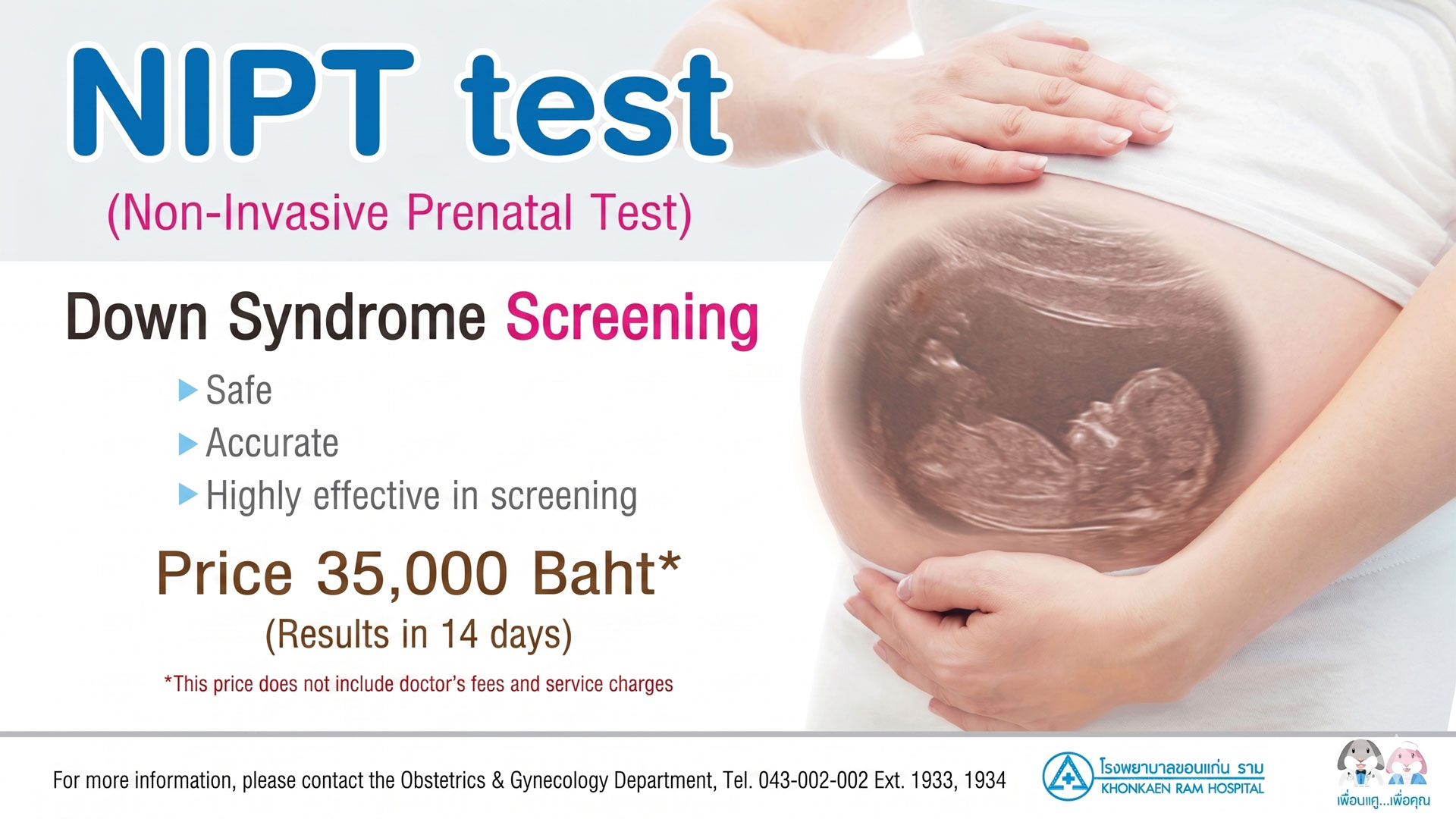
What is NIPT?
NIPT, or Non-Invasive Prenatal Testing, is a screening test to detect chromosomal abnormalities in the fetus without any risk to the unborn baby. It is a test to determine the risk of Down syndrome or other chromosomal abnormalities, and can also determine the sex chromosomes or the sex of the fetus.
Abnormalities
Normal human chromosomes consist of 23 pairs or 46 chromosomes (22+XX or 22+XY). Chromosomal abnormalities can occur from an extra chromosome (Trisomy), a missing chromosome (Monosomy), or when parts of certain chromosomes are missing (Microdeletion).
Chromosomal abnormalities are related to increasing maternal age. For example, a 25-year-old mother has about a 1 in 1,100 chance of having a baby with Down syndrome. For a 35-year-old mother, the chance is 1 in 350, and it increases to 1 in 100 for a 40-year-old mother.
However, some chromosomal abnormalities are not related to maternal age and may be caused by other factors such as genetics or chemical exposure.
Eligible Gestational Age
- The test can be performed from 10 weeks of gestation onwards.
How is the test performed?
- The test is done by drawing 16-20 cc of blood from the mother. NIPT is a safe procedure as it analyzes fragments of placental DNA that are present in the mother's bloodstream.
Accuracy
- The test has a high accuracy of over 99% for detecting abnormalities in the number of chromosomes 13, 18, and 21, and about 92% accuracy for abnormalities in the number of the X chromosome.
How long for the results?
- Results are available within 2 weeks.
Examples of Abnormalities
- Down syndrome is the most common, caused by an extra copy of chromosome 21 (Trisomy 21). Symptoms include a small brain, small skull, flat back of the head, small and flat nose, wide-set eyes, upward-slanting eyes, and a small oral cavity which can make the tongue appear large. The tongue may be fissured. Slow bone growth leads to short stature and short fingers. Abnormal palm creases are common. Intellectual disability is typical, with an I.Q. ranging from 20 to 50.
- Edwards syndrome is caused by an extra copy of chromosome 18 (Trisomy 18). Symptoms include an abnormally shaped back of the skull, close-set eyes, a small mouth and jaw, and a small head size. There may be skin folds on the outer eyelids and low-set ears. Cleft lip and palate may be present. Fingers and toes are often clenched or malformed. Heart and kidney defects are common. Infants usually pass away within the first year.
- Patau's syndrome is caused by an extra copy of chromosome 13 (Trisomy 13). Symptoms include low birth weight, a small head, small or absent eyes, cleft lip and palate, wide-set eyes, a broad and flat nose, a small chin, low-set ears, extra fingers or toes (polydactyly), deafness, heart defects, and kidney abnormalities. Most infants pass away at a young age, with 80% passing away within the first year.
- Turner syndrome is found in females and is caused by a missing X chromosome (Monosomy X), resulting in a 45,XO karyotype. Symptoms include female external genitalia, short stature, a webbed neck, a broad, flat chest, and small, widely spaced nipples. The genitals do not fully develop, and the ovaries and uterus are small, leading to infertility.
Recommendations for the Test
The NIPT is an initial screening test for abnormalities. Additional testing methods may be necessary based on the physician's discretion. You should receive specific advice from your obstetrician-gynecologist regarding this test.
Note
- Price is for the laboratory test only.
- Price does not include doctor's fees and hospital service fees.
- Prices are valid from January 1 to December 31, 2026.
- The hospital reserves the right to change prices without prior notice.
For More Information
- Obstetrics and Gynecology Clinic, G Floor, Building 2, Tel. 043 002 002 ext. 1932
- Health Information Center, ext. 1905