Laser Lithotripsy
What is Laser Lithotripsy?
Laser lithotripsy is a procedure for treating stones in the ureter. It involves using an endoscope (a small camera) to locate the stone, followed by using a laser beam to fragment the stone into tiny pieces, which are then removed. The remaining small fragments will pass out naturally with urine.
Laser lithotripsy is a non-surgical, incision-free method that does not require penetrating the kidney tissue. It is highly safe and effective, with minimal blood loss, less pain, and fast recovery, allowing patients to return to their normal lives quickly.
Where can it be used to treat stones?
It is used to treat stones lodged in the **ureter** (the tube connecting the kidney to the bladder) or stones located close to the bladder.
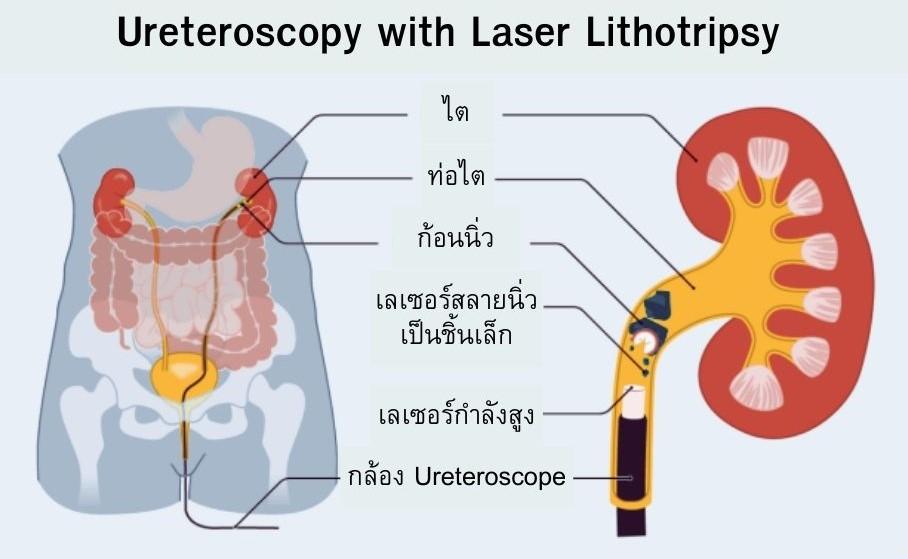
Laser Lithotripsy Procedure
- Before the procedure, the doctor will administer **general anesthesia**.
- The doctor then uses a small scope (**Ureteroscopy**) inserted through the urethra, into the bladder, and up into the ureter until the stone is reached. A laser beam is then used to break the stone into small fragments.
- Afterward, the doctor will typically insert a **ureteral stent** for about 1–2 weeks to ensure that urine and small stone fragments can drain out easily. The patient is then scheduled to have the stent removed via cystoscopy.
- The procedure takes approximately 1.5 hours, or possibly longer depending on the size and location of the stone.
- Once the lithotripsy procedure is complete, the patient will be moved to the recovery room for about 2 hours, and then transferred to an inpatient room. The patient will stay in the hospital for about 1-2 days before the doctor deems them fit for discharge.
Preparation
- Fast (no food or water) for at least 8 hours.
- Inform your doctor of any underlying medical conditions and stop taking anticoagulant (blood-thinning) medications for at least one week before the procedure.
How to care for yourself after laser lithotripsy?
- Attend all follow-up appointments as scheduled.
- For the first 1-2 days, avoid strenuous work or activities.
- If you experience difficulty urinating, decreased urine output, fever, or chills, see a doctor immediately.
How to prevent recurrence
- Drink 2-3 liters of clean water daily.
- Avoid salty and pickled foods, as they can strain the kidneys and reduce their function.
- Exercise regularly for at least 20-30 minutes every day to help prevent the sediment formation that causes stones.
- Eat a balanced, nutritious diet with plenty of vegetables. Reduce or avoid meat consumption, or substitute with fish.
Cost of Ureteroscopic Laser Lithotripsy
Approximate Price: 120,000 - 160,000 THB
Note
- 1 night, 2 days hospital stay.
- Price includes doctor's fees, service fees, room charges, meals, and take-home medication.
- Price does not include pre-procedure assessment and follow-up examinations.
- The price may change depending on the doctor's assessment or in case of complications.
- The procedure is performed under general anesthesia.
- Prices are valid from January 1 to December 31, 2026.
- The hospital reserves the right to change prices without prior notice.
For More Information
- Urology Clinic, G Floor, Building 1, Tel. 043-002-002 ext. 1920
- Health Information Center, ext. 1905


Related Packages
ผ่าตัดนิ่วในถุงน้ำดี แบบส่องกล้อง
แผลเล็กเจ็บน้อย ฟื้นตัวเร็ว ลดภาวะแทรกซ้อน
Men's Sexual Health Restoration
No pills, no supplements—Treat and restore performance with FSWT.